The Tower of London
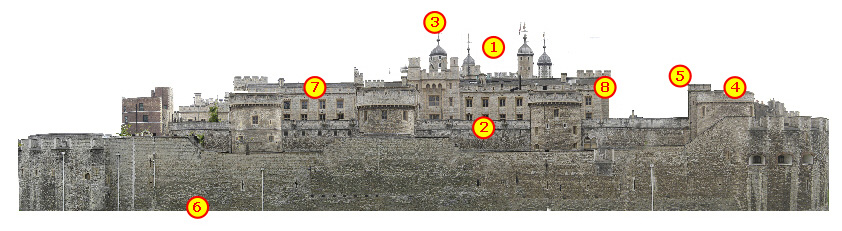
> There are in fact 21 towers at the Tower of London. In the centre is the keep, the 'White Tower' (1) which was built by William the Conqueror, making it the oldest stronghold in Europe. Over the years the site has been progressively fortified by adding moats and defensive curtain walls (2) in a concentric pattern.
> The White Tower has four turrets; the round one (3) was used as an observatory. Today the Tower is used to display the collection of arms and armour, but originally this is where the King would have lived, on the top floors away from danger, and with his court on the floors below. The terrible 'Little Ease' prison cell is at the bottom, just 4ft square to prevent any prisoner from standing up or lying down.
> Beauchamp Tower (4) was used as a prison and there are inscriptions carved on the walls by the prisoners who were held there.
> When the moat (6) was drained in 1830, human remains were discovered amongst the rubbish at the bottom.
> Executions inside the grounds were unusual, but were used when a normal public execution might carry the risk of social unrest. After execution the prisoners were laid to rest in the Chapel Royal (5).
> The glacis, an open sloping area around the White Tower for defence, probably saved the building from catching alight during the Great Fire of London in 1666.
> A final refortification of the Tower was made during Queen Victoria's reign when the state was feeling under threat from the Chartist movement with their demands for political reform, and the Waterloo Barracks (7) were added with accommodation for 1000 soldiers. The Jewel House (8) at the end of the block is home to the famous crown jewels.
> The Tower of London website can be seen here.